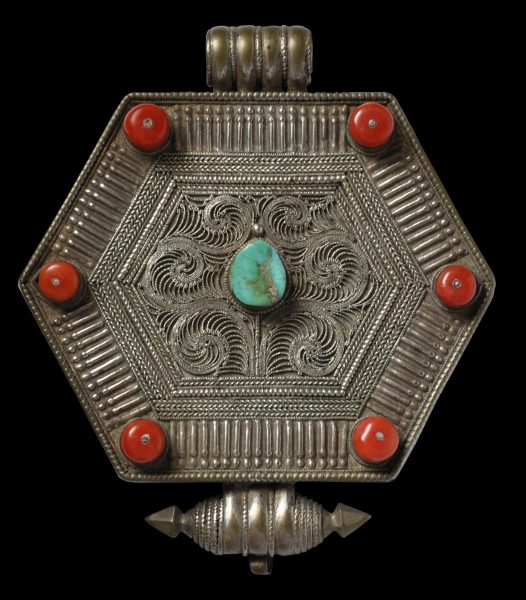
Silver is an important material in Tibetan jewelry, as it is considered to be protective. Along with silver, their jewelry often includes other materials, such as coral, turquoise, and yak bones, all of which have sacred or protective properties. (For a brief overview of symbolism in Tibetan jewelry, here is blog article that may be interesting). While many of the design choices in Tibetan jewelry are related to Buddhism and spirituality, the aesthetics of the jewelry is important to the culture. According to China Tibet Online, Tibetan woman Man Ta says,

“We are very proud of our culture. We think that our clothing and jewelry are the best, the most beautiful. So we wear this in order to tell people, ’I am a Tibetan’, that we are proud of our culture.”
In an article on Tibetan silversmithing, Chandra Reedy outlines the technological tradition and how it has changed to suit contemporary needs and constraints. Traditional Tibetan silversmithing has been threatened in recent years because of competition with Chinese manufacture, as well as the Cultural Revolution which “forced [craftsmen] to stop working and take up other jobs”. There also have been new laws which state that silversmiths must buy silver from the government whereas it was traditionally bought directly from miners in Tibetan regions, or through trade with China and India. Despite these setbacks, the craft still exists in small-scale family-run workshops with the father passing on his knowledge to his son.
Reedy’s article follows a silversmith, Trang-than-long, in Sichuan Province, China who had been trained in this way, and maintains his silver workshop with the assistance of his wife, as silversmithing requires many hands (as we have been made aware). Trang-than-long solely creates commissioned pieces for a primarily Tibetan consumer which are either based on samples he has in store, or described to him by his patron. I have outlined the steps he takes in order to complete a commissioned bracelet by summarizing what has been relayed in Reedy’s article. I highly suggest taking a look at the article for a nuanced description of these processes, as well as to see the photos, which are integral to understanding what is happening in these processes.
- Design: Meets with patron and discusses the product to be made.
- Materials: Estimates how much silver will be needed for the project; weighs it out. Decides what other materials will be involved in the final product (turquoise, coral, etc.).
- Price: Agrees on a price based on the weight of silver, additional materials, and the intensity of labor involved.
- Resource acquisition: The silversmith does not smelt his own materials, but buys them in ingots, which he obtains through the government if not already bought in advance.
- Work the silver ingot:
- Flattens, stretches, and reduces thickness through hammering
- Uses hand roll mill to flatten completely—a nontraditional method
- Shapes piece by hammering on an iron anvil while annealing with torch
- Measures piece
- Make silver wire (for filigree design):
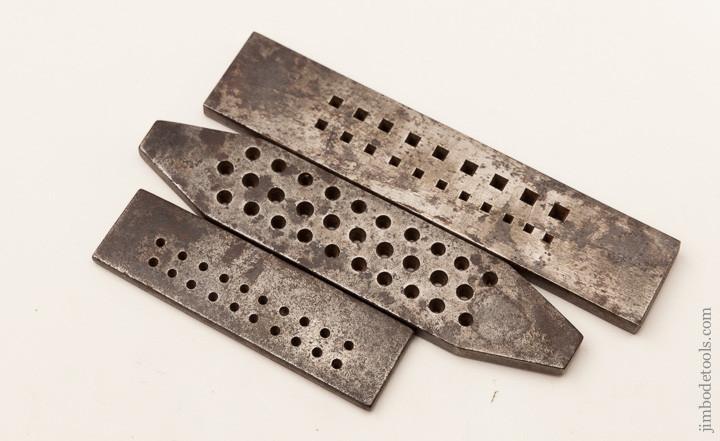
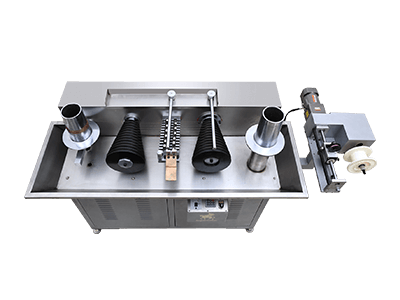
- Uses thin hammered pieces of ingot to begin drawing through a draw plate
- Stands on stool, holding drawplate with foot while pulling with tongs
- Rolls two strands of wire together on the floor while pounding with block of wood
- Heats strands to fuse them together
- Uses tweezers to shape into filigree design
- Solders onto flattened silver base with silver powder flux
- Granulation (for decorative spheres):
- Cuts small clippings of silver, or snips off bits of twisted wire to make circlets
- Uses torch to heat silver on refractory brick while assistant operates foot bellows—traditionally he used a charcoal furnace
- Stacks silver spheres (created from torching) together to form a clump
- Torches the clump to fuse together
- Places spheres on bracelet using tweezers
- Fuses with base by soldering with torch and silver powder flux
- Assembling and finishing:
- Cuts main panel to size with silver snips
- Shapes it by using wooden forms and mallets
- Files the piece to smoothen
- Places decorative panel on silver band, which is held in place by wires
- Adds moistened silver powder between pieces using tweezers
- Assistant operates foot bellows and torches for him as he manipulates jewelry
- Removes wire holders after soldering complete
- Places in pickle solution and cleaned with brush to clean fire scale
- Dries, reheats, and washes again several times thereafter
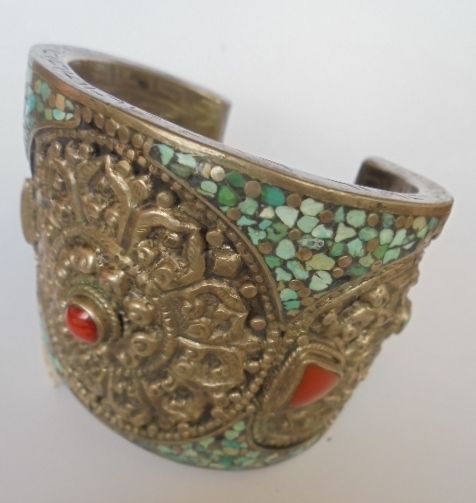
Silver bracelet with coral and turquoise inlays. From Catawiki.
This list of steps Trang-than-long takes in order to create a bracelet is also of little help in truly describing his chaine operatoire. It does, however, exemplify the continuity of a silversmithing process which has been passed down to him through his father and the ways he decides to adjust these traditional practices. Overall, it outlines the steps one would take in a silversmithing workshop, broadly. According to Reedy, “the workshop processes are consistent with those of traditional silversmithing and jewelry making in other parts of the world”. While this may be true of the processes on a surface level, she does not take into consideration his inner thought process when executing these processes—the order in which he does things, the way he holds the materials and tools, how he goes about deciding which designs to undertake, and even the choice to employ the help of his wife as an assistant where usually there would be a male apprentice. What does this say about Trang-than-long, his jewelry, and the context of his jewelry? How do his methods differ from others?
References:
Reedy, Chandra L. “Technological Tradition and Change in Tibetan Silversmithing Techniques in Songpan, Sichuan Province, China.” MRS Proceedings, vol. 1319, 2011, pp. mrsf10–1319-ww09–09., doi:10.1557/opl.2011.742.
 Jewelry Making Technologies